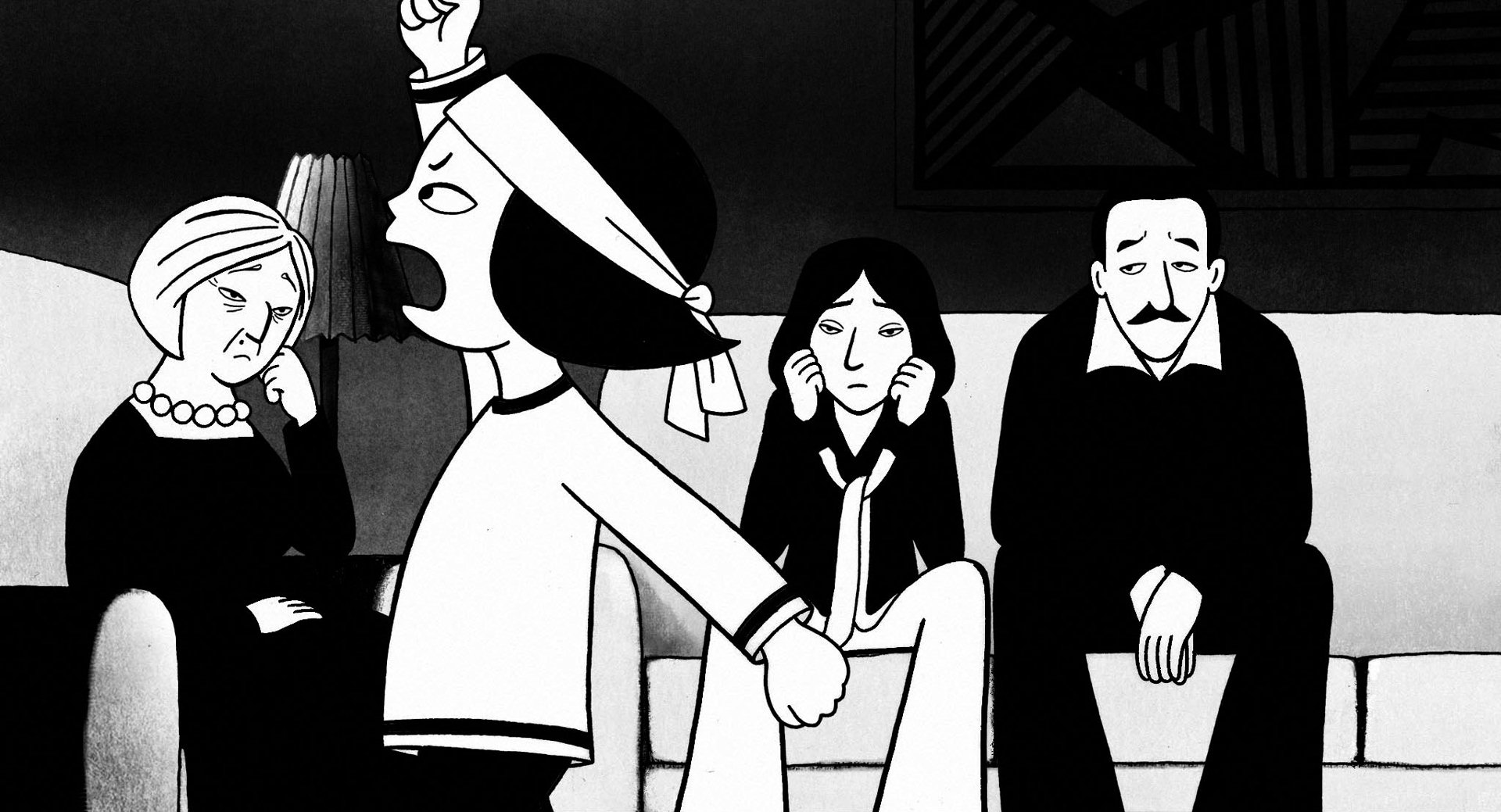
Week 13: Persepolis

Image result for persepolis

Literary Analysis

This week we concluded Persepolis and watched the film in class, which I felt really tied it all together. The main theme that I felt was portrayed throughout the whole story was on the cultural stereotypes and gender barriers that the women faced during the Islamic Revolution. Women were viewed as the inferior gender than men, and had these “rules” that they were forced to follow such as wearing the headpiece to cover themselves, and when they did not they were treated poorly and were disrespected. In a recent article that I used for my AJA presentation, a study was done that showed women are less likely to defy the rules and social standards, especially when it comes to religion and social standards. What I found interesting was that in Persepolis Marjane is not afraid to be herself and to go against the social norms to please everyone. She has her own fashion style and music choice and does not try to fit in like the rest of the women in her country.

Personally, I do not know how I would act if I had such strict standards and rules that I would have to follow because I am so used to being my own person that it would be hard to put my ego and self esteem aside. Even when it comes to religion, I am hard headed when it comes to following certain traditions “rules” like the ten commandments.

Discussion Question:

When have there been points in your life (if any), when you have doubted your faith or even considered breaking the religious barrier and stereotypes?

References:

Satrapi, M. (2004). Persepolis: The story of a childhood. New York, NY: Pantheon Books. 

Week 12: Persepolis

Image result for persepolis

Literary Analysis

This week we began a graphic autobiography by Marjane Satrapi called Persepolis, that shows and explains about how her life was growing during the Iranian revolution. I had never heard about the Iranian revolution, mostly because it was not talked about in any of my history classes. I had a single story for the women and men from that country, one being that the women are oppressed and the other that the males were terrorist. Now as much as I think that, that used to be true to an extent, and that there are people who are still oppressed in today’s society and people who will always be looking to cause hate and pain in the world, we have progressed towards having a better understanding on the topic. Especially with having watched the documentary on the Iranian Revolution in class, I learned things that I did not know had happened or even could be possible. I can begin to imagine how difficult it could have been to have a normal childhood or even life in those type of conditions with having spies and soldiers everywhere. Even then, the actions that the US were taking during this whole situation are very questionable in my opinion because the way it was explained in the video kinda showed how they were just intruding in overthrowing a government that was not necessarily hated by the people, but only because it was hated by the Britain. It makes me wonder how the US government is even capable of causing such reck with out taking the people of their country into consideration.

Luckily, I can safely say that I never felt like I have lived in danger or in fear here in the US. I know that our government in far from perfect, especially with the current president that we have who is selfish, racist and sexist, but I think that past presidents like Obama really made my home country feel safer. The energy that was going around in my childhood was not stressful or fearful as it is now, but that just goes to show the difference from when someone who is respected is in power and not someone who is feared.

Discussion Question:

How do you feel about not having to currently deal with the type of problems Marjane faced as a child growing up during the middle of a revolution? How do you feel about the whole concept of the United Staes interfering in the revolution?

References:

Satrapi, M. (2004). Persepolis: The Story of a Childhood. New York, NY: Pantheon Books.

Week 11: Blood Child

Image result for habit
In one of the readings from this week, the author mentions a rule #6, that primarily revolves and focuses heavily on your habits.

Literary Analysis

In this week’s reading from Octavia Butler’s Blood Child and Other Stories, there was one short story that caught my attention in particular called Furor Scribendi because it did not seem like the previous short stories in the book. Butler describes a set of rules that she believes are ideal and worked for her in her successful career as a writer. Out of all six rules, the last one was quite interesting to be because it addressed the topic of habits, good or bad. Octavia describes how our habits are the most reliable things we should trust, over any other skill or action that is not for sure. The theme of success and the sacrifices one must go through to be higher up in a certain society or category, really resonates on what habits you have. If you have good habits and a few bad habits or behaviors that you never do, then it weighs our to rely more on your good habits to get the job done. The sacrifices she mentions that as a writer one must do, in my opinion, seem realistic and accurate considering how far Octavia Butler got in her career. In the afterword, she mentions how she wrote this as almost a piece of personal advice because no one was there to give her an insight on the industry nor on how to properly go about her writing.

Personally, I am not a big fan of writing for fun or in my spare time, but I think that if I was a full time writer and felt a deep passion for it, I would consider Octavia’s advice and do attempt to go through on everything she listed as rules. I believe the success of her career considering all the hard work she went through on her own, speaks for itself on how reliable and valid the rules she listed are. I do feel that in a sense habits are potentially more reliable because it is something you are used to doing and something that you know you are capable of doing, which make sit non the less harder to break, change or get rid of.

Discussion Question:

Did you find the rules that Butler mentioned to be useful for a writer? Do they make sense and seem reasonable? Why or why not?

References:

Butler, O.E. (2005). Blood Child and Other Stories (2nd ed.). New York, NY: Seven Stories Press.

Week 10: Blood Child

Related image
The image represents the internal conflict one could feel within their-self when in a hard or tough decision regarding someone else’s life.

Literary Analysis

This week, we began a book called Blood Child and other short storiesby Octavia E. Butler, which as the title implies, it includes multiple short stories about utopias, dystopias, and science fiction. There was one short story called “The Evening and The Morning and The Night” that I wanted to discuss in particular because it brought a certain theme to my attention which was how there is struggle and pain within one’s own body when you are mental fighting a sickness or depression or anxiety. In the short story, the story line includes a generation of humans who have cancer and take a supposal cure but has a long-term effect on their offspring by giving them a mental and physical health sickness that if not controlled, induces suicide. Generations later, the main characters are battling the illness by trying to control their thoughts and feelings even though it is extremely difficult. The more I thought of the difficult decision it must be to have to choose to live with yourself every day even though you are not living a normal life due to a sickness that you did not choose to have and was pushed upon you. I found it also to be quite interesting on how the company that created this “cure” for the cancer but caused the defects among the offspring, also makes medicine to control that illness. This also brought up an important theme of how in today’s society the people causing the problems, are also trying to create solutions to the problems themselves. It seems completely ironic and unfair that there are companies and such that actually cause harm and then try to remediate it as a scam to take people’s money for their own personal enjoyment. 

Personally, the reading left me with multiple questions and doubts on how society can function so terribly because of the unfair tyranny that goes on in higher up divisions. Yet the one question that really made me wonder and think was of how does one decide to take a medicine to save yourself but in the long run cause harm to someone else. In the short story, the people with cancer did not know that it caused a defect on their children, but the situation still made me wonder what the value of life is.

Discussion Question:

If you were in a situation where you had an illness or sickness such as cancer, and could take supposedly a cure or medicine that would save your life but would for a fact damage your future children, would you still take the medicine?

References:

Butler, O.E. (2005). Blood Child and Other Stories (2nd ed.). New York, NY: Seven Stories Press.

Week 8: The Poet X

The image represents the fact that mothers give their daughters affection but it is empty, as they look for consolation in the relationship between each other.

Literary Analysis

In this week’s reading from The Poet XElizabeth Acevedo, we concluded the novel, and there were a few readings that really stood out for being in the ending. The one I really related to in particular was My Mother and I, because Xiomara made some statements that were short yet so deep and profound with feeling about the relationship she has with her mother, that I began to really feel her struggle. In the poem she talks about how the physical contact of her mother hugging her, is the consolation she has because since they are both hard headed with their beliefs, none of them would apologize first. Xiomara describes how the action of them hugging each other, does all the talking for them. She also talks about the hope that one day her mother will give her sincere affection and accept her for the way she is. Yet I also found it kind of ironic of how she says their so much alike and that is what causes them so much trouble to get along, because I think that Xiomara’s mother might have had the same attitude Xiomara has now when she was her age, but since she wasn’t allowed to say her ideas she was basically brain washed.

Personally, I have been in a rough patch with my mother where I felt that we were so confused and emotional with each other, no words could express how we felt. All my mother and I would do to show emotion was hug and cry. It was in that moment that I realized that I never wanted to feel that type of desperation and anxiety where my voice felt trapped, and my mother was not understanding me. Although her hugging me felt soothing, it did not allow me to say what I was thinking or what was on my chest. Eventually my mother and I overcame the rough patch and we have now developed a better way of communicating with each other and having open mindsets so we are not as hard headed and closed to new ideas and opinions.

Discussion Question:

Have you ever felt completely lost or do not know what words to use to express your emotions with your parents (particularly your mother)? Has physical contact with a loved one, ever been the only type of response you needed to feel at ease?

References:

Acevedo, E. (2018). The Poet X. New York, NY: HarperTeen.

Week 7: The Poet X

Image result for a girl depressed
The image represents the possible emotions and body language that Xiomara feels and shows when her mother constantly yells at her, bringing her self confidence and self esteem down because she is always told to change her ideas.

Literary Analysis:

In this week’s reading from the novel The Poet X by Elizabeth Acevedo, there was one poem in particular that really stood out to me for several reasons, and it was called How I Can Tell. This poem really spoke to me because I found it to be an extremely relatable theme for adolescents not only in a Hispanic household but also within all cultures and races. I chose to elaborate further on the idea of how we learn to distinguish the different types of mad among our parents, because we know them so well, we often predict how they are going to react to something that they find unpleasant. In this novel, the main character Xiomara, can distinguish between her mother being mad, and her mother being mad and disappointed and almost anxious at the fact that Xiomara does not act like a proper young lady, or at least not like what Xiomara’s mothers envisions. Xiomara believes that her mother is really mad when her Spanish words begin to mesh together as the speed increases and it is hard to fully understand what she is saying. Yet the real problem is with the reasoning behind why Xiomara’s mother gets mad at her, because there is no justification for not learning to accept and love your daughter for the way she is. In context, Xiomara is always getting reprehended because she breaks the rules that her mother wrongly enforces because they deprive her of her freedom and personality. If her mother was mote accepting and understanding, Xiomara would not be yelled at or shamed for being who she is. 

Personally, I can also distinguish when my mother is mad, really mad or disappointed mad. If I break a simple rule, that is not super serious, she would get mad but let it go soon after. If I do something to make her really mad, she would punish me in some type of way either by taking things away or grounding me. Yet if my mother is disappointed mad, I know I have seriously done something wrong or caused her to pass an emotionally unpleasant event because this is often when she will not ground me or take things away, but she will ignore me and give me the silent treatment.

Discussion Question:

How do you feel when your mother or father reprehend you for being yourself or having your own ideas and beliefs? Can you tell when they are mad or when they are really mad? If so in what ways are the two distinguished?

References:

Acevedo, E. (2018). The Poet X. New York, NY: HarperTeen.

Week 6: The Poet X

Image result for someone torn between two personalities
The image is a deeper look of the comparison that is made between Caridad and the author in the poem Caridad and I Shouldn’t Be Friends, as she is torn to fit this mold of the ideal young woman.

Literary Analysis:

This week, we began a novel called The Poet X by Elizabeth Acevedo, which is primarily telling a story through poems. Based off the first set of poems, I predicted that the novel was going to be telling her personal life story which includes her perspectives and opinions on different things such as religion, feminism and oppression, with the cultural background she upholds as a Dominican-American. There was one poem in particular that caught my attention named Caridad and I Shouldn’t be Friends, in which the author mentions religion as a main theme that she uses to compare herself to her friend Caridad. She depicts how in her cultural, her parents and family look a religion with a great amount of respect, and look at ideas that contradict or break their rituals as mistakes. For example, one stanza in the poem implies the comparison and concept of the virgin Mary, when she mentions that she was interested in liking a boy, and how Caridad was going to wait till marriage which is a common rule or as priest call it maintaining morals, in the catholic community. This concept ties back into the idea that has been portrayed upon the author of what a well educated young woman must be like, but throughout the poem is broken and shows a different take on how it is okay to not match the standards that are pushed on young woman. Every woman is entitled to their own choices whether that be with what they choose to do with their body or what beliefs they choose to follow.

Personally, I could extremely relate to this poem, since it really reflects these ideas that I constantly hear around me everyday. Growing up in a hispanic household, while attending private catholic school, I was always told what to do and what not to do, and what was proper and what was incorrect. One of the main ideas that really began to be repeated in my household was the sin of sex before marriage, or at least that is how my parents and family members worded it. Constantly hearing this message, caused many emotions such as distrust, as if my parents did not think I was responsible enough to make the right choices. I feel that this happened even more so since I have a female cousin my age, as we were always compared to each other to see who was better or more well behaved.

Discussion Question:

How do you personally feel when you are compared to someone else by your parents or family members? If you compare yourself to others on your own, what is the purpose on doing so? Does it push you to have a more positive perspective on things or negative?

References:

Acevedo, E. (2018). The Poet X. New York, NY: HarperTeen.

Week 5: This Bridge Called My Back

Related image
In this past weeks reading, a theme that was presented was about privileges based off the color of your skin that overpowers the race.

Literary Analysis

One reading that really caught my attention from this week’s book called This Bridge Called My Back Fourth Edition by Cherrie Moraga and Gloria Anzaldua, was a piece written by Mirtha Quintanales called I Paid Very Hard for my Immigrant Ignorance. My attention was immediately drawn by the title of the letter because I imagined that it had something to do with a certain race that is primarily classified as immigrants, but I took the surprise of realizing it was more focused on what classifies someone as a woman of color in an immigrant setting. She depicts how within the community of women, in immigrants, they discriminate among each other based of their skin color, and just because some are lighter than others, they don’t think they go through the same amount of problems that a darker immigrant woman would. She goes into depth specifically on her personal story as a lighter skinned Latina, and how it she almost felt as if it was a burden to have lighter skin because she was not accepted in her cultural community. One of the main aspects of this reading that I concluded was significantly important, was the lenses that everything was being looked at through. Often in today’s society, people choose to ignore the perspective of women in general, not just immigrants or of color, and when people choose to look at immigration they only tend to see the stereotype of the hard working male Mexican immigrant and not of the women who are constantly keeping the family together. It seems unfair that the woman figure is constantly over looked as it is assumed to be an easier role than a man, but it is even more unfair when woman judge each other within their cultures.

Personally, I consider myself a dark-skinned Latina because my family has always given me nicknames such as “prietita” or “guaresita” which refers to my skin color. Therefore, I was leading to believe that I had darker skin so when I would compare myself to my friends I always assumed I was darker. Yet in my mind, I believed that since I was a darker skinned Latina, I would fit in better with my friends in Mexico, until I began to get older and they started to judge me and call me “guerita” because I was lighter than them. This created an internal conflict with myself and my identity because I did not know if I was Mexican or White since I was hearing two different stories based off my skin color. Eventually, I found peace with myself in the concept that I will never be able to please two groups of people that think they are completely different based off their skin color.

Discussion Question:

How is it possible that people can be ignorant with people within their own race and culture just because they do not look the same? Why do they envy the person instead of providing support and a sense of belonging given the fact that in the end they are all being discriminated?

References:

Moraga. C., & Anzaldua, G. (2015). This Bridge Called My Back: Writings by Radical Woman of Color(4th ed.). Albany, NY: State University of New York Press.

Week 4: This Bridge Called My Back

Image result for this bridge called my back pic
The image represents woman feminists that wore shirts to resemble how they are labeled as “kitchen tables” to show how their backs are used as “bridges”.

Literary Analysis:

            This week we began a new book called This Bridge Called My BackFourth Editionby Cherrie Moraga and Gloria Anzaldua. In the reading assigned for this week, there was a poem called “And When You Leave, Take Your Pictures With You” by Jo Carillo, which really touches several different controversial and sensitive topics revolving around creating a single story based on stereotypes, racism and even more so, feminism. Many people define those powerful words in different ways, I choose to describe them as best as possible instead of directly stating what I personally think they mean. In the poem, the single story that is typically created for woman of color and immigrants, is broke down by addressing the assumptions. For example, “sitting at a factory machine; welding a machete; in our bright bandanas” (Carillo, 2015) is a way of showing how important of a role feminism can play in ending the single story because woman immigrants are assumed to be working at a factory or dressing a certain way which is stereotyping people. Throughout the rest of the poem, Carillo constantly addresses the reader as a audience as “our white sister” (Carillo, 2015), as it reminds the reader of what it would feel like to switch seats, to be stereotyped by group just because your race or gender.

            In my personal opinion, I started with interpreting the title of the poem to mean something along the lines of, when you are done judging someone, take the image you created of them with you because it might not be completely accurate. I believe that in today’s society, we are far from being open minded to new ideas and concepts, including feminism and single stories. There is a tendency to create bias excuses to seeing the negative side of things such as how most people tend to assume all immigrants are of dark skin, or how feminist hate men. We as a society should begin to show more progress towards acceptance of people who have their own equal rights and beliefs.

Discussion Question:

Why is it that we are so quick to create a single story about a certain race, just based upon stereotypes? Is there a bias trait that causes us to do this subconsciously as well as consciously ?

References:

Moraga. C., & Anzaldua, G. (2015). This Bridge Called My Back: Writings by Radical Woman of Color(4th ed.). Albany, NY: State University of New York Press.

Week Three: A Raisin in the Sun

The image above represents the kitchenette building that was the name of a poem by Gwendolyn Brooks.

Literary Analysis

This week’s reading included one poem, one called “Kitchenette building” by Gwendolyn Brooks, which I found fitting to our theme from A Raisin in the Sunby Lorraine Hansberry which is somewhat a reflection of her life. Lorraine’s father, Carl Augustus Hansberry, was one of the most known real estate for creating more affordable living for African-Americans while the effects of racism and segregation were still in effect during the 1940’s. He transformed what would be one apartment into two, and split them from the kitchen, and from there the term kitchenette arose. Now in the poem “Kitchenette Building”, there is a message between the lines as to how the problems that African American’s faced with having to conform to the idea that the dream of prospering out of poverty was very far from reality, and even farther of being considered a possibility. There is a comparison of several analogies such as “But could a dream send up through onion fumes; Its white and violet, fight with fried potatoes” (Brooks, 1963). I interpreted it as a way of saying how the dreams fade away into a distance, and how the vegetable are fighting amongst each other, much similar to how the white people do not want to get along with the African-American people.

In my personal opinion, I feel that Gwendolyn Brooks was trying to express the bigger picture of how African-Americans had to put their dreams away because in the reality that they lived in the not only the 1940’s but for several years before and after that, because they were condemned to conforming themselves with this idea that it was the reality. I found it to be an interesting twist with using the kitchenette as the basis point, but it made complete sense as it tied into our theme from Lorraine Hansberry and her father, based on their lives. I also felt that the poem reminded me of how I should be grateful for not only the things I have today, but for the fact that as a brown skinned Chicana, I did not have to experience such conditions. 

Discussion Question:

Does it seem fair that African-Americans had to live in such poor conditions due to segregation when in a “normal” society today, people of all kinds of races live amongst each other? What is your opinion on the progress we have made so far with racism in today’s society?

References:

Brooks, G.(1963). kitchenette building.: Harper & Row.

Hansberry, L. (2004). A Raisin in the Sun. New York, NY: Vintage Books.